
Quick Answer
Agentic commerce could generate up to $1 trillion in U.S. retail revenue by 2030, according to ICSC and McKinsey & Company. Getting a share of that starts with getting recommended by Alexa for Shopping and Walmart Sparky — AI shopping assistants that sit closest to the point of purchase and read product content to answer a shopper's question, not to match a keyword. Alexa for Shopping has been used by more than 350 million shoppers over the past year and helped deliver nearly $12 billion in incremental annualized sales last year. Sparky customers build baskets roughly 35% larger than those who don't use it. Content that doesn't answer the question won't get surfaced. Brands that fix it see real movement: across CommerceIQ's customer base this kind of content optimization has driven 2 to 10% sales lift depending on the category, and Newell Brands cut content updates from 30 minutes per SKU to under a minute, a 40x improvement. Getting there means auditing your content for gaps, rewriting it to answer real shopper questions, and getting the fix published on the retailer page.
If you missed our recent webinar, Capturing the Trillion Dollar AEO Opportunity, this post covers the key takeaways and what you can act on right now.
Table of contents
- Shoppers stopped searching & started asking
- How Alexa & Sparky are different
- Answer Engine Optimization builds on SEO — it doesn't replace it
- Brands are losing sales over this right now
- How AllyAI for Content optimizes AEO at scale
- Three things to do this week
- Frequently Asked Questions
Shoppers stopped searching & started asking
Type "stain remover" into Amazon's search bar and you get thousands of results. Ask Alexa "what's a good stain remover for kids' clothes that won't irritate sensitive skin" and you get a handful of answers. That's the shift happening right now. A third of Amazon searches are already questions like that, not keywords, according to Adam Colasanto, CommerceIQ's Director of GTM for Agentic Products, who has been tracking the data closely.
The numbers back up how fast this is moving. Alexa for Shopping has been used by more than 350 million shoppers over the past year, with interactions up five times year over year, and it helped deliver nearly $12 billion in incremental annualized sales last year, when it was still branded Rufus. On Walmart, about half of app customers have already tried Sparky, 81% say they've used it to check product details before buying, and Sparky customers build baskets roughly 35% larger than those who don't.
Retail assistants like Alexa and Sparky sit close to the point of purchase, closest to the sale. General AI platforms like ChatGPT, Gemini, and Perplexity sit further up the funnel, at discovery and consideration — this space is often called Generative Engine Optimization, or GEO, and it's a related but separate discipline from what this post covers. This post focuses on Answer Engine Optimization, or AEO: the retail assistants sitting closest to the point of purchase.
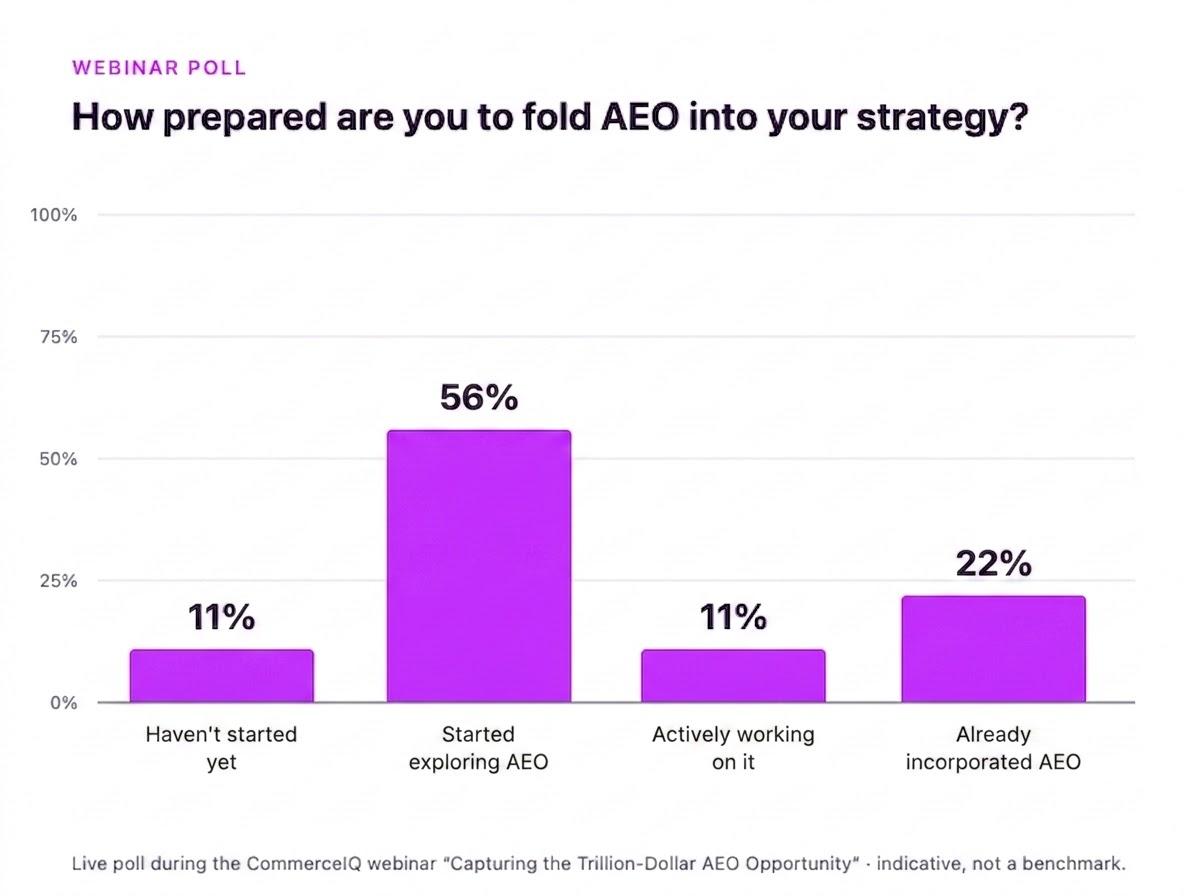
Caption: Asked live on the webinar how prepared they felt to fold AEO into their existing strategy, most attendees said they had started exploring it. Far fewer had finished.
How Alexa & Sparky are different
Alexa leans on Amazon's own ecosystem — reviews, community Q&A, product history. Sparky shows up in more places: inside the Walmart app but also through ChatGPT and Gemini, though those third-party surfaces reportedly convert at about a third of the rate of Walmart's own site. The fundamental core is the same across all retail AIs, as Lucia Li, Customer Success Director at CommerceIQ, explained during our recent webinar: "Now, where it's different is how they appear and where they appear."
Lucia has a real example of this. Looking for a Father's Day gift, she started with Gemini for ideas, then went to Alexa on Amazon.ca, since her father lives in Canada, and asked for golf recommendations. She ended up sending him a mini putting set, sourced entirely through two different AI assistants before she ever looked at a product page herself.
| Platform | Where it appears | Key data source | Conversion note |
|---|---|---|---|
| Alexa for Shopping | Amazon app, Echo devices, Amazon.com | Amazon reviews, Q&A, product attributes, sales history | Customers who use Alexa for Shopping spend 40% more per order on average |
| Walmart Sparky | Walmart app, ChatGPT, Gemini | Walmart product catalog, customer reviews, in-store inventory | Third-party surfaces convert at ~33% of Walmart's own site rate |
| General AI (ChatGPT, Gemini, Perplexity) | Standalone platforms, browser extensions | Public web, retailer sites, brand content, reviews | Discovery and consideration stage; earlier in the purchase journey |
For a deeper look at how Alexa for Shopping evaluates listings and what brands can do about it, see Why Alexa for Shopping demands a new digital shelf playbook.
Answer Engine Optimization builds on SEO — it doesn't replace it
Traditional search still drives most discovery traffic today. Clean titles, strong imagery, and backend keywords still matter, and they're also exactly what an AI assistant needs to read a product correctly in the first place. "SEO is not going away," Lucia said. "Don't pull all your budget away from SEO and put it into AEO. It's additive."
The fundamentals haven't shifted. What's new is a deeper layer of Answer Engine Optimization sitting on top of them — descriptions and bullets built to answer the questions a shopper is actually asking, not just the ones a keyword tool would suggest. And it's already paying off: customers who use Alexa for Shopping spend 40% more per order on average than shoppers who don't.
Brands are losing sales over this right now
More than half of AI shoppers (50.9%, according to Envision Horizons' 2026 AI Shopping Shift report) have abandoned a purchase after the AI flagged a concern about a product. Almost all of that traces back to data problems: vague specs, inconsistent claims, information the AI couldn't verify.
Brands already running AI optimization on their PDPs are seeing direct impact on sales and conversion, according to Adam Colasanto, CommerceIQ's Director of GTM for Agentic Products, and that impact compounds fast once it's applied across a full catalog. Across the pilots run by CommerceIQ, content optimization has driven real sales lift, ranging from 2 to 10% depending on the category.
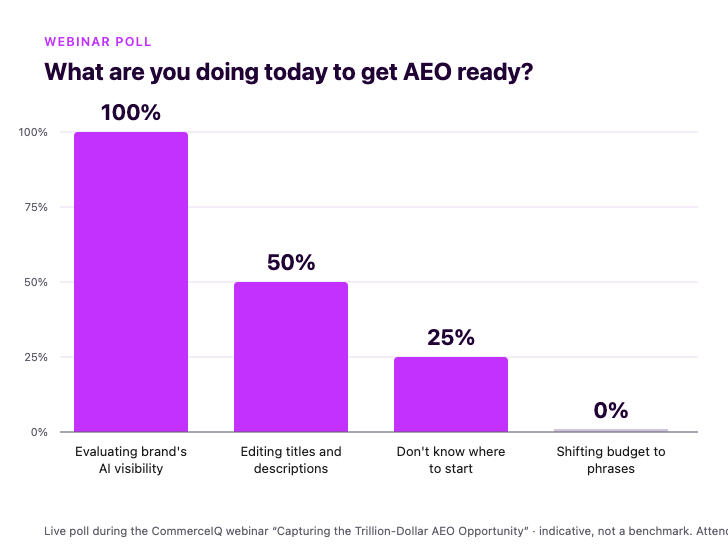
Caption: The gap shows up in what teams are actually doing. Asked live what they were doing today to get AEO ready, every attendee said they were evaluating their brand's AI visibility and half were editing titles and descriptions, but nobody was shifting budget from keywords to phrases. Diagnosis is happening; reallocation is not.
How AllyAI for Content optimizes AEO at scale
AllyAI for Content benchmarks a brand's current content against category best-in-class and what competitors are already doing well. Instead of a generic score, it prioritizes which SKUs to focus on and pinpoints the exact problem, whether that's missing attributes, thin copy, inconsistent claims, or weak Q&A.
From there, it rewrites the content for how Alexa and Sparky actually read a page: front-loading direct answers, filling in the structured attributes that AI assistants pull from, and keeping claims consistent across every retailer. It's built to satisfy retailer-specific rules and category nuance at the same time, not a generic AI rewrite.
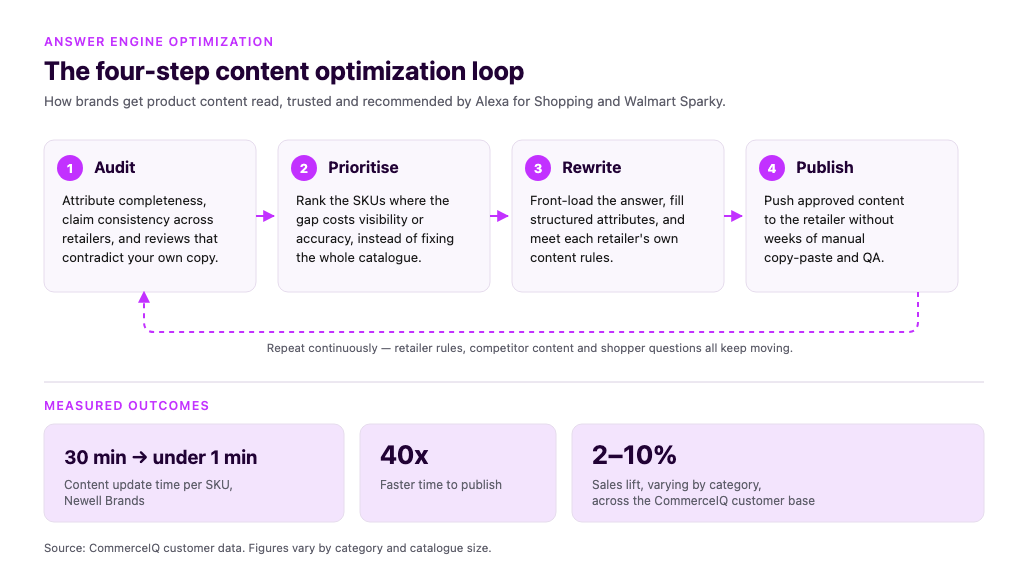
Caption: The four-step AEO content optimization loop: audit for attribute and claim gaps, prioritise the SKUs where the gap costs visibility, rewrite to answer shopper questions, then publish to the retailer. Newell Brands cut content updates from 30 minutes per SKU to under a minute, a 40x improvement, and content optimization has driven 2 to 10% sales lift depending on category across the CommerceIQ customer base.
Newell Brands used AllyAI for Content to automate product content updates across their catalog, cutting what used to take 30 minutes or more per SKU down to under a minute — a 40x improvement in time to publish. Read the full Newell Brands case study.
Three things to do this week
- Check your top 10 to 20 SKUs by revenue for completeness. Look for missing attributes, inconsistent claims across retailers, and any reviews that contradict your own product claims.
- Ask Alexa and Sparky the actual questions a shopper would ask about those same products. If a product isn't named, or is named inaccurately, that's your gap between what's on the page and what the AI is actually surfacing.
- Need help figuring out where you stand? Request an AI Visibility Report. Get a clear picture of your content gaps, competitor visibility, and where you're losing to AI screening, without doing the audit manually.
This post follows our recent webinar on AEO and agentic commerce.
Frequently Asked Questions
Answer Engine Optimization (AEO) is the practice of structuring content so an answer engine can read it, trust it, and use it as the answer — rather than optimizing purely for keyword-based search rank. It applies to any engine that answers questions instead of returning a list of links: Google's AI Overviews, ChatGPT, Perplexity, voice assistants, and retailers' own shopping assistants. In ecommerce it means answering real shopper questions directly in your product copy, filling in the structured attributes assistants read, and keeping claims consistent across retailers so the engine can verify your product and cite it.